Far beyond the numbers: when the EoC's commitment generates a future – and also a present. The OPLA report on the use of EoC International funds in 2025 to combat poverty
by Tainã Santana
When we think of an annual report – especially in the business world – numbers, graphs, and growth curves immediately come to mind. These are useful indicators, of course, for answering a recurring question: “Do we have more resources than last year?” For OPLA, which focuses on people in vulnerable situations, the question is different and much more demanding: “Have we really contributed to overcoming poverty?”
We also collect data and create graphs, but we do so in order to try to grasp something deeper: real changes in people's lives. Because in today's world, numbers alone do not transform reality. It is stories that change it, especially when they tell of possible paths.
 The end of the year thus becomes a precious time to stop and look back, to recognize the steps taken. And the starting point can only be people: men and women who, together with their communities, face their own vulnerability and that of those around them every day.
Esther, Pedro, Mary, Dian, Sofía, José, Olívia, Hector, Gerardo, Sebastián, Esteban, Mauricio, Águeda. These are just some of the names we have encountered this year. Names that tell the story of the EoC today and tomorrow. Through their stories, we see how the closeness and commitment of the EoC have supported concrete paths of redemption: from educational support to health, from housing to accompaniment in income-generating activities.
The following data is not intended to impress, but to make visible what really matters: the often arduous but real journey towards overcoming poverty. This report concerns the use of EoC International funds in 2025. The impact of these investments will be verifiable at the conclusion of the individual interventions (integral human development projects and individual support actions).
In addition to the data we see here, there are many others: those of people who, without going through EoC International, live communion every day and put it into practice as a way of combating poverty. In fact, we hear from many communities around the world different stories about how they have managed to cope with various situations of need by pooling what they had.
And this is precisely the intent of the EoC, even at the international level: that communion can be lived locally at all levels. Indeed, from our experience over the years, we are understanding that communion can be one of the key factors in overcoming conditions of vulnerability, and hearing this confirmed in so many stories from around the world makes us realize that we are on the right path.
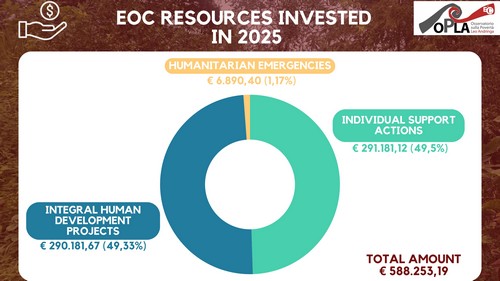
 As far as the funds that pass through the International EoC are concerned, the action takes place within a real ecosystem of communion. OPLA, together with local operators around the world, accompanies individual support actions; AMU, on the other hand, promotes and implements integral human development projects. It is in this context that the EoC resources allocated to combating poverty in 2025 are placed.
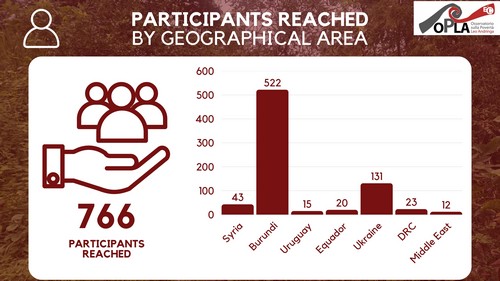
Through the integral human development projects carried out by AMU and supported by the EoC, 766 people have been reached. In Syria, with RESTART, a microcredit and business incubation project, and with Semi di Speranza, dedicated to social and health care; in Burundi, thanks to microcredit and microfinance programs; in Uruguay, with Volver a empezar, for post-prison social and work reintegration; in Ecuador, with the Sunrise project, which involves young people in environmental protection; in Ukraine and the Middle East, in response to conflict-related emergencies; in the Democratic Republic of Congo, with support for income-generating activities and microcredit.
Sahran, a Syrian painter involved in the RESTART project, describes the change he has experienced:
“This compressor I received from the project is a great help in my work because it allows me to continue working for half an hour even when there is a power outage. I can deliver to customers faster, which increases my earnings.”
Lydwine, a seamstress in Burundi who participates in the microcredit and microfinance program, also emphasizes the value of the shared journey:
“By working together with others, I was able to learn from their experiences and improve my financial management. The microloans obtained by the group allowed me to purchase the necessary materials and grow my business.”
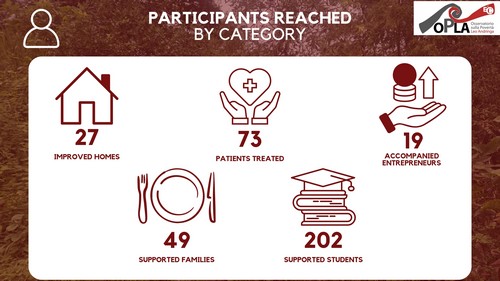
 Alongside the projects, there are also individual support actions, accompanied by OPLA operators in different countries. In this area, 370 people have been reached through interventions in housing, health, nutrition, income-generating activities, and scholarships. Many of these stories have been told throughout the year.
Today, however, we feel the need to express our special gratitude to the local operators: without their attentive listening and constant presence, none of this would be possible. Throughout the year, we have also walked together through monthly meetings, where each operator brought their own situations and, together, we sought the most suitable solutions. Encouraging results are emerging from this shared work: more and more people are able to continue on their own path, leaving room for others who are in greater need.
Juliette, a midwife in the DRC, reminds us that even in contexts marked by corruption, there is an alternative:
“Here, a woman who is about to give birth often knows that she will have to pay extra money to be assisted. There are midwives who demand it. We young people must change this mentality. I have talked about it with my colleagues and no one in our group takes extra money.”
Mauricio, a dance and folklore teacher in Argentina, talks about the impact on his neighborhood:
"Thanks to you, we can prevent many children from spending their afternoons or evenings on the streets, in dangerous places. They can stay in a safe place, such as during dance classes. In this way, we offer them an alternative and prevent them from going down the wrong path.”
Perhaps, having come this far, we can return to the initial question with greater awareness: have we really contributed to overcoming poverty in the world?
The stories, the paths we have embarked upon, and the concrete steps we have taken together tell us that the answer is not a slogan, but a real journey, made up of relationships, shared responsibility, and a future that is beginning to take shape.
Download the pdf OPLA 2025 Report (24.02 MB)