Editorial - Even though he may not have been a disciple of Jesus, he put into practice the most important instrument of the Christian faith: his feet.
by Luigino Bruni
published in Avvenire on 04/03/2026
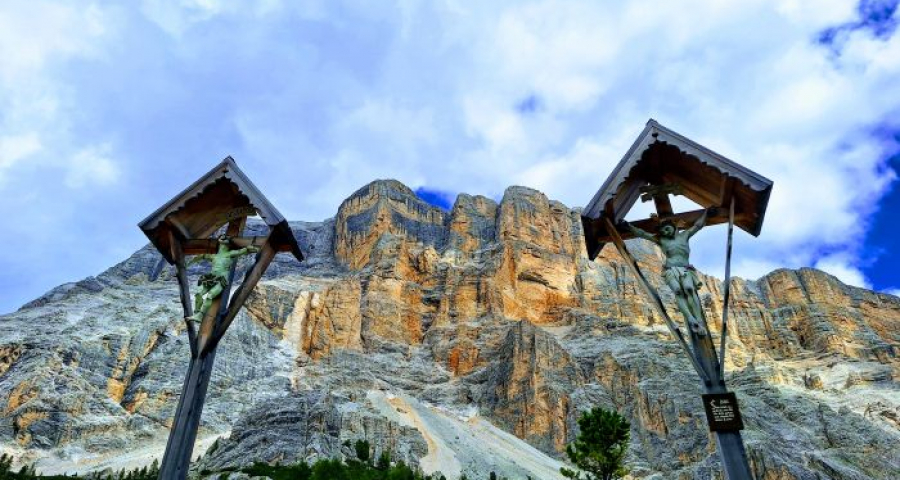
Waiting for him on the final hill of his earthly life, Golgotha, Jesus does not find three tents: he sees three crosses, one of which is his own. At his sides are not Moses and Elijah, but two thieves. Jesus Christ is the center of this unique and unrepeatable day in history. But, as in great works of art, to understand its overall meaning we must also look for and examine the details. Two of them are entirely human, very human indeed, yet they make the scene of that Friday even more divine.
One of them is Simon of Cyrene, the first person Jesus encounters along his “Way of the Cross,” most likely a historical figure, mentioned in all three Synoptic Gospels. Simon of Cyrene is an anti-hero, a man like so many others, passing by at the right moment in the ‘wrong’ place (he was returning from the fields)—a wrong place that would become his right place, where he made his silent and involuntary entrance into the history of salvation. He found himself commanded to carry a cross that was not his own. He had no choice, and yet he is one of the most beautiful figures in the New Testament. Not all of us will die a death like that of Christ or the martyrs, but all of us, sooner or later in life, find ourselves in the condition of the Cyrenean, bearing a cross we neither wanted nor sought—and woe to us if such moments were never to come: at least once. And there, through that human gesture—not even a virtuous one (because it just happens to us)—we enter into the lives of children, husbands, wives, mothers and fathers, friends, and colleagues, and together with them we write a mysterious story of salvation.
The Cyrenean became a disciple without choosing it; he began his following of Jesus without a call, perhaps spurred on by a soldier’s frustration. He exercised, when perhaps he was not even a disciple of Jesus, the most important organ of the Christian faith: the feet. The Cyrenean is the anti-leader, and he reminds us that the first and essential act of the Christian is following—walking behind, not ahead; and that whoever finds themselves tasked with guiding someone else will never be a good guide if, before, during, and after that task, they do not also know how to walk behind those they guide.
On that stretch of road, the Cyrenean perhaps never even saw Jesus’ face, eyes, or mouth. He saw only bloodied hair, heard moans and cries; a back, a spine, flogged shoulders, perhaps a disfigured profile. He saw Jesus from behind, and by taking up a cross not his own, he fulfilled the words: ‘Whoever wishes to come after me, let him take up his cross…’ (Mt 16:24). Like Moses, who saw only God’s back, not his face, and that was enough for him (Ex 33). The Cyrenean is thus another man who saw another God from behind. Who knows how many people, beneath a cross, are seeing God from behind today! It is the great multitude of Jesus’ unwitting followers, who, beneath their own crosses and those of others, see him only from behind and do not recognize him.
Christians have loved the Cyrenean dearly. Many did not know the theologies of the cross, but everyone understood the Cyrenean, and so they entered the heart of the Bible even without ever having read it. Because they knew that the “calling” of fathers and mothers is the calling of the Cyrenean: to stand beneath their children’s crosses, to lift them up along their Calvary, at least for a stretch, as long as one can and must. Mark (15:21) gives us the names of Simon of Cyrene’s sons: Alexander and Rufus. They were therefore known to the community, perhaps even part of it—it is beautiful to imagine that those sons were converted upon seeing their father carry that cross: because it still happens, because it happens to us too.
Luke also handed down to us the dialogue between Jesus and the two men crucified with him. That great dark night of the Bible and of humanity is illuminated by words that only Luke chose to preserve and recount to us; a final dialogue with the poor and the outcasts, right to the end. Jesus dies in company; his last earthly act was a “where two or three.” A friend of humanity to the very end, a companion to the victims to the very end. That dialogue was the last time Jesus said, “Blessed are the poor”—who is poorer than one crucified?
The “good thief” was perhaps a good man who ended up on that cross (how many good people are there in prisons!); perhaps he had heard some of Jesus’ words, and so knew he was innocent. And he says to Jesus: “Remember me.” In reality, that man is also telling him something else: “Jesus: remember, in this pitch-black darkness, that you are Lord of a good and different kingdom: remember yourself. Remember who you truly are: ‘don’t forget yourself.’” When life nails us to the cross, when everything speaks of failure and death, in that total and radical disorientation, the presence of someone beside us who invites us to remember who we truly are is perhaps the only presence truly necessary for salvation.
In that final dialogue, for the first and only time in all the Gospels, we read the word “paradise” (“... when you are in paradise”). It emerges as the last word on the lips of a man condemned to death. To glimpse something of paradise, we must approach those hung on the wood in the many Golgothas of our earth, hoist ourselves into mid-air, and there press the ear of our heart to their breathless mouths.
If, today, we wish to hope that we may still encounter the Risen One, we must seek him among the crucified, not in the empty tombs. “My God, my God, why have you forsaken me?” was the first song of the Risen One.