The desire to restore dignity to Kayan women and to preserve a tradition that was disappearing was the driving force behind the initiative described by the author of this story
Myanmar, formerly known as Burma, has been in conflict since 1948, shortly after independence. It is a multi-ethnic country where various communities inhabit the outlying regions, while the central plains are predominantly populated by the Bamar people. The conflict arose primarily from ethnic minorities’ demands for autonomy following the country’s unification.
 For eleven years, I worked with an international organization supporting communities displaced by conflict. In 2017, I visited a mountain village accessible from Loikaw, my hometown, via a two-hour drive followed by a difficult motorcycle ride along rugged trails passable only during the dry season. Many community members had returned from the border areas with Thailand, where they had temporarily sought refuge. I realized that many women—especially the elderly—wanted to continue weaving, but had no access to yarn. The colleague who had preceded me had promised to procure it, but had been transferred before she could do so. I felt a duty to honor that commitment.
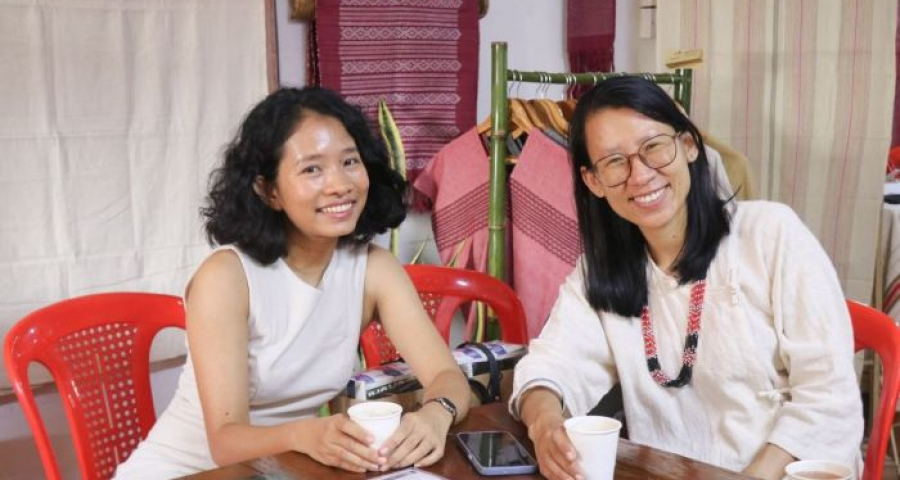
My sister worked for another organization that promotes community-based tourism and supports traditional weaving. In her free time, she experimented with natural dyes made from bark, flowers, leaves, and turmeric, dreaming of bringing our artisanal heritage back to life. One obstacle was the lack of cotton, which was no longer being grown, so synthetic yarn had taken over; furthermore, the elderly women who preserved traditional knowledge were passing away. It saddened her to see villages selling products imported from Thailand as “traditional,” far removed from our Kayan culture—that of the “long-necked” women, so called because of the brass coils they wear around their necks. Many tourists came to visit the Kayan communities across the border, but this risks turning them into “human zoos.” The desire to restore dignity to Kayan women was a fundamental driving force behind our initiative.
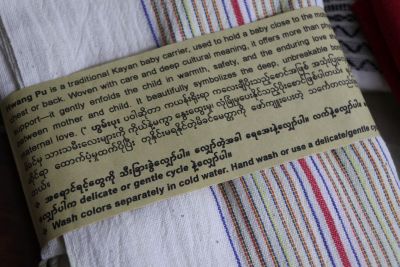 As a first step, our mother and grandfather began growing cotton again, and I ordered colored yarn for the village I had visited. My former colleague contributed the funds she had always wanted to donate, and I served as a liaison between her, my sister, and the craftswomen. Our shared goal: to preserve a tradition that was disappearing.
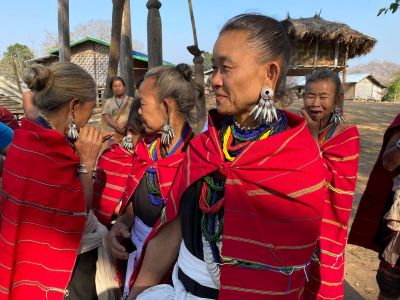
Back in the village, the women welcomed us wearing their traditional red dresses and proudly showing us their fabrics. Even a door-to-door saleswoman who had moved to our city told us she knew how to weave and would have preferred to earn a living that way. My sister provided her with yarn, and a few days later the woman returned with a beautiful piece of authentic Kayan handicraft. From that moment on, she became one of the artisans at Ngi Mu, the weaving center my sister launched in 2019 with five weavers on fixed looms, five on backstrap looms, and three staff members. Ngi Mu supplied products to three hotels and a retail outlet in the capital, Yangon: bathrobes, pillowcases, table runners, handkerchiefs, and clothing. The center was also designed as a destination for creative tourism, featuring workshops on natural dyeing and weaving. Although only one group of tourists participated in a workshop, the project continued to grow: by 2020, the number of looms had already reached five.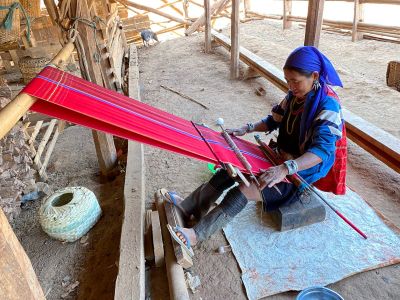
In 2021, following the military coup, the conflict reached our area as well. Ngi Mu temporarily became a refuge for villagers fleeing the violence, but then we were forced to abandon everything. When hope seemed lost, others believed in us and supported us. So in 2024, however, Ngi Mu resumed operations in Yangon, thanks to an initial grant of $500 from “Weave a Real Peace,” a global network supporting artisans, which allowed us to purchase two looms. This time, the vision expanded: no longer a single cultural tradition, but connections with artisans from different ethnic communities. In 2022, my sister had met women from the Mro community, displaced from western Myanmar and settled on the outskirts of Yangon since 2017, following the Rohingya crisis. The Mro are one of the country’s smallest ethnic groups, with their own textile tradition. Initially, we supported their children with weekly meals; today, the Mro weavers are an integral part of the Ngi Mu network. Another group of craftswomen from Moe Bye is rebuilding their community in a sparsely populated area of the country thanks to two looms we were able to provide them and thanks to the leadership role played by a couple—he a technician, she a production coordinator.
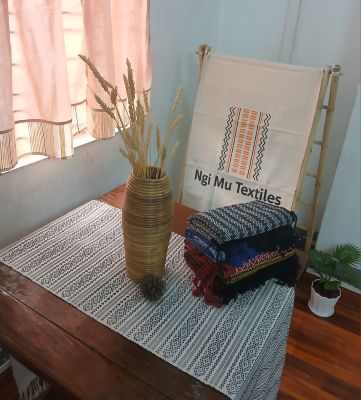 At first, we had no space, and the proceeds were barely enough to cover the cost of raw materials and the weavers’ labor, as they worked from home. But by the second year, we were able to pay the rent for a workshop and set aside a small sum to cover other operational expenses, such as transportation, communications, and related staff costs, while we ourselves were still not receiving any compensation. Now that we are in our third year, a better balance is emerging between costs and revenues, partly because we have devoted more energy to selling the fabric stock that was accumulating. Our customer base has expanded to include four other stores in the capital, which also operate online, and we ship part of our production to the border with Thailand and even to Italy, specifically Milan. Our main challenge now is ensuring a steady supply of the types of products in demand.
Today, Ngi Mu is a social enterprise 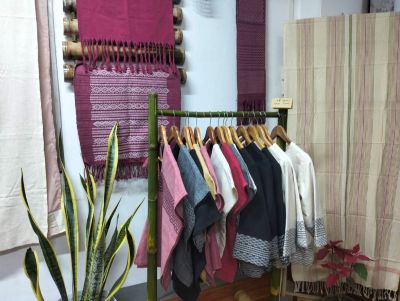 -albeit a small one that employs twenty craftswomen from five ethnic communities and works with eight organizational partners. In 2025, thanks to the Korean Economy of Communion, a training program for entrepreneurs was launched, and in 2026 the program was expanded. Our experience has taught us that poverty in conflict-affected communities cannot be addressed solely through financial aid. People need opportunities that allow them to put their skills to good use, preserve their identity, and contribute to the community with dignity. And it has shown us how small actions can bring about significant change.