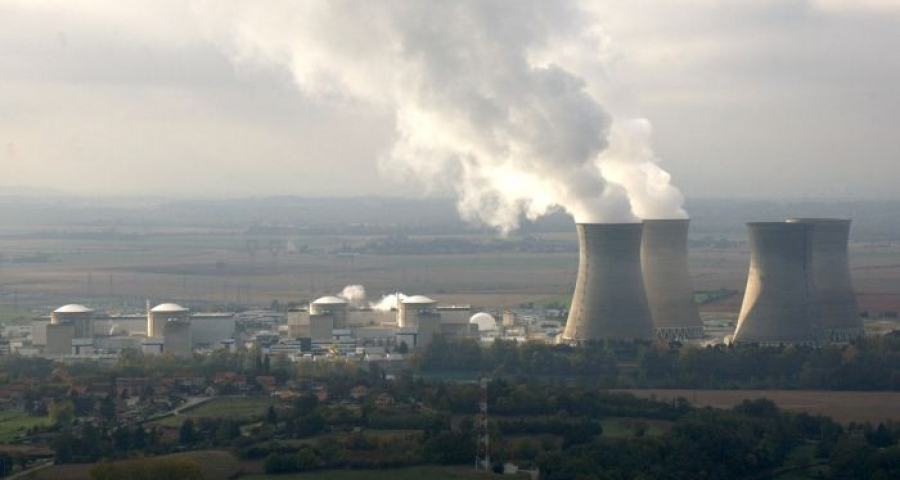
The temporary shutdown of some French nuclear power plants highlights their vulnerability to the effects of extreme heat. New environmental challenges are also emerging in the natural gas sector and regarding global emissions
by Alberto Ferrucci
published in Città Nuova on July 2, 2026
The temporary shutdown of two more French nuclear reactors during the current heat wave is a sign that goes beyond mere news coverage. The decision by Électricité de France (EDF) to shut down the plants at Nogent-sur-Seine and Bugey—following the earlier shutdown of a reactor at the Golfech plant—was not driven by technical or nuclear safety issues, but by the need to comply with environmental limits on the temperature of river water used for cooling.
This episode demonstrates how even a reliable and predictable energy source can be affected by extreme weather events. Nuclear power does not depend on wind or sunlight, but requires large quantities of water to dissipate the heat produced by the reactors. When river flows decrease or water temperatures rise, cooling capacity is reduced. Continuing to use it without restrictions would mean returning it to waterways at temperatures high enough to harm aquatic ecosystems.
For this reason, environmental permits impose specific limits that EDF has chosen to comply with by temporarily halting production. This issue primarily affects plants cooled with freshwater, while coastal plants are generally less vulnerable.
Economically speaking, these outages can temporarily reduce the supply of electricity and affect prices, especially during summer peak demand periods. According to the French grid operator, however, the available capacity remains sufficient to meet national demand. France generates about two-thirds of its electricity from nuclear power and is one of Europe’s leading energy exporters; Italy is among the importing countries, which uses part of the low-cost French energy at night to power pumped-storage hydroelectric plants, storing energy to be released during peak consumption hours: the shutdown of the reactors could reduce Italy’s ability to import electricity.
This incident thus reopens the debate on the resilience of energy systems. Heat waves are becoming increasingly frequent and intense, and it will be necessary to design facilities better suited to the new climatic conditions, develop cooling systems less dependent on freshwater, and continue diversifying the energy mix. Nuclear power continues to be one of the sources of electricity with the lowest CO₂ emissions during operation, but, like all large industrial infrastructures, it must contend with the effects of climate change.
This news is accompanied by another development, which is also significant from an environmental perspective. ENI and XRG, an international subsidiary of the Emirati energy group ADNOC, have announced their participation in the development of a project to export liquefied natural gas from the Vaca Muerta field in Argentina, one of the world’s largest reserves of shale gas (natural gas trapped within rock formations, ed.).
Exploiting the field requires the use of hydraulic fracturing (fracking), a technology that has revolutionized U.S. gas production: in fact, numerous studies indicate that methane leaks during extraction and production significantly reduce the climate benefit of natural gas extracted in this way compared to other fossil fuels, since methane has a much greater climate-altering potential than carbon dioxide.
It cannot be ruled out that the widespread adoption of fracking over the past decade is one of the contributing factors to the current acceleration of climate change. To date, ENI has developed most of its liquefied natural gas production through conventional fields. Its entry into the Vaca Muerta project therefore represents a significant evolution of its industrial strategy. It will be essential for ENI’s creativity to give rise to new extraction technologies capable of limiting methane emissions and preserving natural gas’s contribution to the energy transition.
Although these two news items concern different technologies, they convey the same message: energy security can no longer be assessed solely in terms of resource availability and production continuity. We must also consider the ability of infrastructure to adapt to climate change and the commitment of operators to reduce environmental impacts throughout the entire life cycle of their operations.
Photo Credit: © Spiritrespect - wikimedia.org