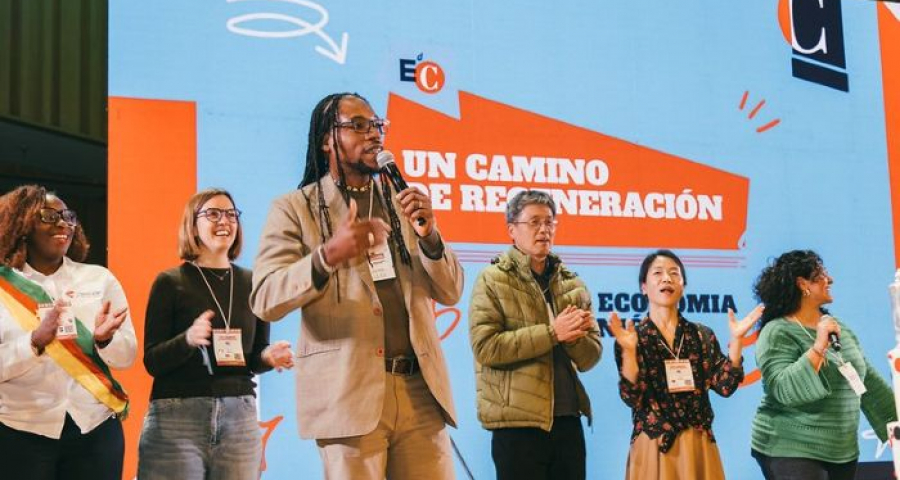
At the EDC 35th Anniversary Forum in Buenos Aires, the highlight of the celebration was a global pact signed by all those present, both personally and collectively
by Cibele Lana
We left the participants of the EoC’s 35th-anniversary event at the end of their immersion experience in the 16 local EoC communities that welcomed them in Argentina, Paraguay, and Ecuador, and now we find them in Buenos Aires for the forum that brought them together on May 29 and 30 at the Usina del Arte.
These were days in which the idea resonated that the Economy of Communion is not merely a business model, but encompasses a vocation, a life choice made in freedom. Voices from different countries, cultures, and social classes—such as entrepreneurs, startup founders, community leaders, and indigenous leaders—took turns on stage, highlighting the transformative power of this vocation.
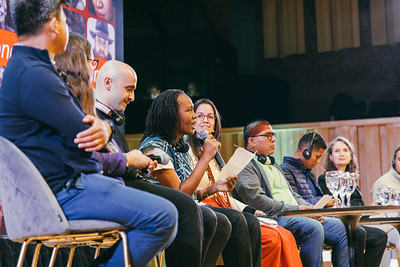 The opening brought together on stage people from different countries, social and business entrepreneurs, and community leaders participating in EoC projects around the world.
Nji Mabih, an entrepreneur from Mabs&Smalls Kitchen in Cameroon, was unequivocal in stating that the EoC has changed her way of working and led her to understand that, in a business guided by communion, the ultimate goal is not profit, but the person. “When you put the person at the center, the business does not suffer, but flourishes.” She continued:
«We allocate our profits toward employee training, the education of vulnerable children, and the well-being of everyone involved in our business. We share generously, consistently, and even when it’s not easy. And, thanks to this communion, our chocolate production has expanded».
Xavante leader Vanderlei Burure Wadi explained how the resources pooled by the Economy of Communion reach his village in the Brazilian hinterland. There, the Supera Program, run by EoC Brazil, funds scholarships for young Xavante people.
«Our people face many difficulties, but we believe that education can help transform this reality. One example is one of our students, who graduated with a degree in Education and now works in his own village, putting into practice everything he has learned.».
Regenerating the earth is a relationship to be cultivated
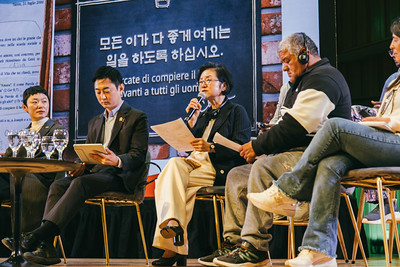 An entire section was dedicated to initiatives that prioritize the regeneration of the earth, with a focus on climate justice. Amata, Kolbe, and Sole, from South Korea, run the family bakery in Daejeon. The business, which started with two people, now has 1,600 employees and welcomes about 12 million visitors a year. One of the company’s projects is Eco Sungsim, which promotes the recycling of milk cartons. Employees, customers, and schools in the region have joined the initiative, and each year, the company offsets approximately 79.2 tons of carbon through this effort.
Gilda Espíndola and Marta Barreto took the stage to represent the indigenous community of Yari Miri in Asunción, Paraguay, and its struggle for land. For decades, they lived in the capital in conditions of extreme poverty. A collaborative effort between community organizations and people of good will succeeded in realizing the community’s dream of acquiring their own land, where they live today. “The transformation of the place was the result of joint work. The community made bricks, built latrines, and became a multiplier, helping other communities obtain land and housing,” they recounted.
The Path of Entrepreneurship in the EoC
Without businesses, there is no Economy of Communion. The path of entrepreneurship in the EoC was also at the center of the event. Once again, a session marked by a diversity of voices, featuring social and business entrepreneurs from France, Brazil, Argentina, Nigeria, and Italy.
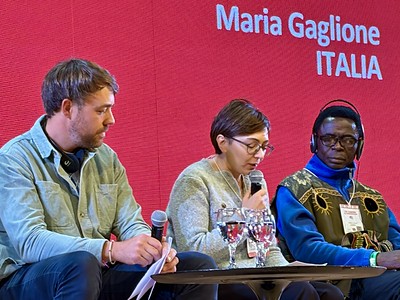 The Polo Lionello in Italy was founded in 2006 and, since then, has faced many challenges, as recounted by Maria Gaglione, the administrative manager. These included the closure of pioneering EoC businesses, the pandemic, and the energy and economic crises. A reality that very well represents the life of entrepreneurship.
“Today, the Hub brings together 42 initiatives, with nearly all spaces occupied: businesses operating in services, manufacturing, and logistics; as well as social and cultural associations and foundations, including the School of Civil Economy, the Economy of Francesco Foundation, and the Risana medical clinic,” she explained.
The path of communion was also chosen by a group of entrepreneurs from the Tucumán region in Argentina when they met in 2021 to celebrate the 30th anniversary of the EoC. They chose beekeeping for its organic nature and the possibility of replicating it in other places. The enterprise operates as an association and already has 140 members in four countries and over 700 hives in production. “Those who join La Novedad agree that, each year, 50% of the profits will go toward scholarships and that each member decides whether to use the other 50% to purchase new hives, sponsor additional scholarships, or anything else they wish,” said Pablo Sustersic.
Beside Sustersic was David Ferro, one of La Novedad’s collaborators.
«Here I feel appreciated; they value my experience and what I know. This is very important for the team, which knows that behind every hive and every jar of honey there are people and their families. It’s something I hadn’t found in other jobs.».
Commitments for the Future
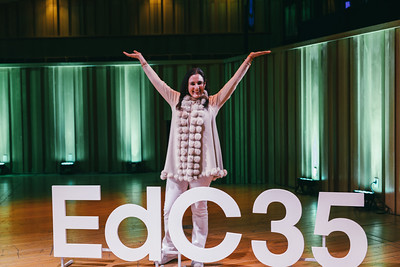 And what are the EoC’s commitments for the future? In a global video conference on the morning of the 30th, nearly 300 more people joined the room in Buenos Aires, connected from all over the world, in what was the highlight of the 35th-anniversary celebration: a global pact signed by all those present, both personally and collectively, to promote a culture within the economy that prioritizes human relationships and seeks to implement regenerative practices capable of fostering communion. A pact that solemnly united and strengthened the entire Economy of Communion network.
This great global community aspires to advance the culture of encounter, to work toward a more just economy, to recognize the central role of people in vulnerable situations, and to contribute to building more fraternal communities.
A quote from Brazilian social entrepreneur and educator Jean Santos sums up these commitments well:
«Regeneration begins from the bottom up, in communities, when we listen to suffering, recognize diversity, and, above all, understand that no one is so poor that they have nothing to give, and no one is so rich that they have nothing to receive».
Also during the live stream on the morning of May 30, two new initiatives were presented to celebrate the present and the future: a new visual identity, more modern, and a new app to connect people, businesses, and projects globally. Visit: www.globaledc.org
 See the extensive photo gallery of the EDC 35th-anniversary event