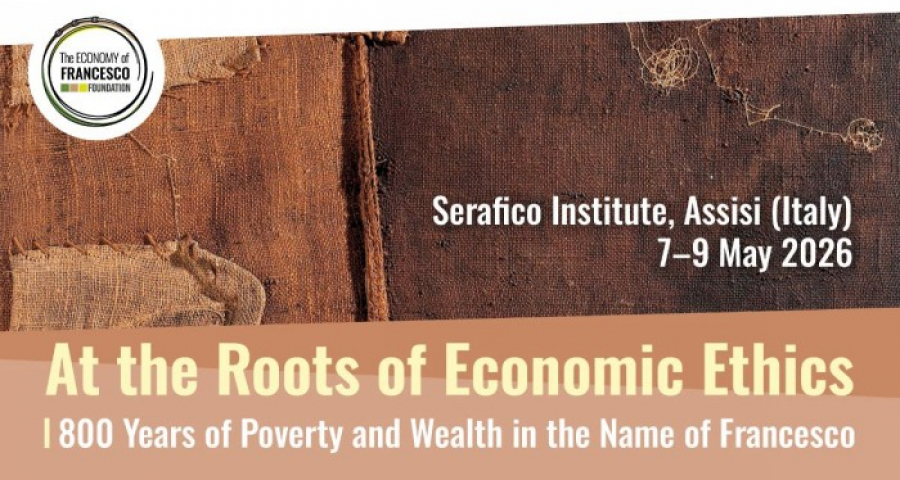
From May 7 to 9, 2026, in Assisi, over 100 scholars, researchers, and professionals from more than 30 countries will gather to reflect on the ethical foundations of economic life, 800 years after St. Francis
At the Roots of Economic Ethics
800 Years of Poverty and Wealth in the Name of Francesco
Source: EoF Press Office
Sponsored by the Economy of Francesco Foundation as part of the Franciscan Centenary, the initiative is organized in partnership with HEIRS – Happiness Economics and Interpersonal Relations and with the support of the National Committee for the Celebration of the Eighth Centenary of the Death of St. Francis of Assisi.
The conference seeks to explore how the Franciscan intellectual and spiritual tradition can contribute to addressing today’s pressing economic challenges — including inequality, ecological crisis, technological transformation, and the search for more inclusive and sustainable models of development. Bringing together economists, social scientists, and interdisciplinary researchers, the initiative is conceived not as a conventional academic event, but as a space of dialogue where different perspectives converge around fundamental questions of economic ethics.
 The program includes keynote lectures by Helen Alford, Giacomo Todeschini and Luigino Bruni, alongside parallel sessions featuring contributions selected through an international Call for Papers. Rather than focusing solely on disciplinary outputs, the conference emphasizes exchange across fields, encouraging dialogue between economic thought, social sciences, and the Franciscan tradition. It also features an entrepreneurial dimension embedded within sessions, where participants move beyond theory into practice through short pitches, presenting real initiatives, testing ideas, and opening spaces for collaboration.
The event will be held at the Serafico di Assisi, a historic institution dedicated to care and inclusion and one of the founding institutions of the Economy of Francesco Foundation. Here, the themes of the conference are not only discussed but lived daily, offering participants a concrete context in which dignity, vulnerability, and the value of every human life are experienced and practiced.
From research to lived experience, participants shape the conversation
Beyond academic discussions, the conference highlights the importance of connecting theoretical reflection with concrete realities and practices. Participants will engage not only through formal sessions, but also through shared moments of encounter, cultural experiences, and informal exchanges, reinforcing the relational dimension of economic ethics.
The diversity of participants is one of the defining features of the conference. Coming from different countries, disciplines, and professional backgrounds, they contribute to a plural and dynamic reflection on the future of economic life. Among them are scholars whose work exemplifies how research can engage directly with pressing social, ecological, and institutional challenges. Among them, Ivan Gozum (Philippines) explores how integral ecology can reshape economic thinking in contexts marked by environmental degradation and governance challenges. In Ireland, Sophie Manaeva examines the role of cooperative models and community wealth building as alternatives to extractive economic systems. From Mexico, Ana Paula Perez focuses on the development of care policies in Latin America, investigating how principles such as subsidiarity and solidarity can inform more inclusive economic frameworks.
 Together, these contributions reflect the interdisciplinary and global nature of the conference, where economic ethics is explored not only as a theoretical field, but as a lens through which to interpret and respond to concrete realities.
A broader reflection within the Franciscan Centenary
The conference is part of the global commemorations marking 800 years since the death of Saint Francis of Assisi. In this context, the initiative contributes to a wider reflection on the relevance of Franciscan thought today.
